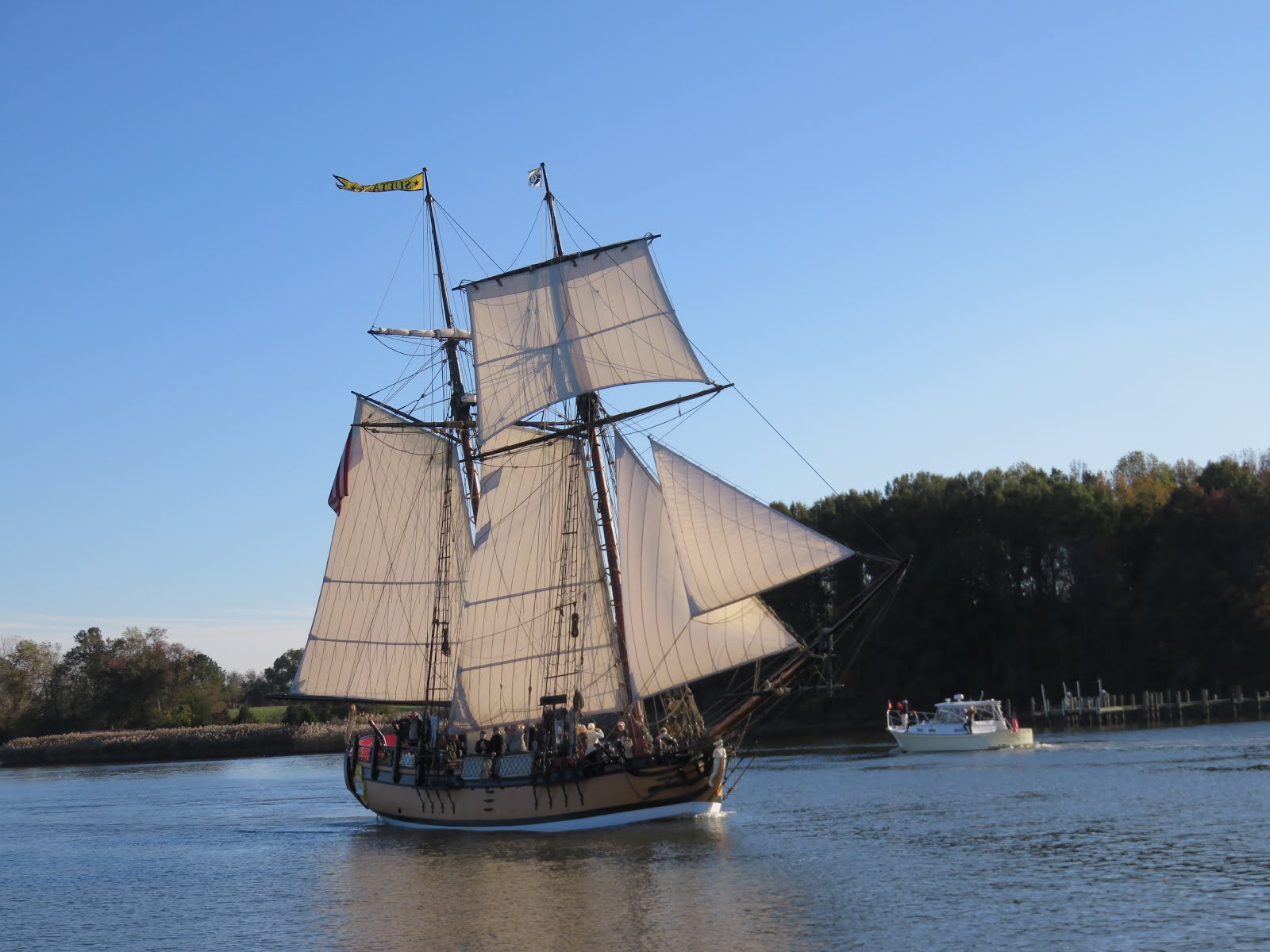
It's been a busy past couple of weekends for me! I did some more tall ship viewing at the Chestertown, Maryland Downrigging Festival, and got a lot of writing done, to boot, as I found staying in this historic town very inspiring:
I also attended the JAFF Writer-Reader Get-Together, and had a fantastic time. It was so great to get to meet up with readers, bloggers, and fellow writers, and talk about Austenesque writing and Jane Austen the whole weekend. I dressed up for tea, as I love to do:
They're gauging interest for a 2020 session, so if this sounds like fun but you weren't able to make it this year, please register!
Well, as it turns out I made that trip to Baltimore sooner than expected! I learned that tall ship Lynx was going to be there along with Pride of Baltimore II. They're both types of schooners known as Baltimore clippers, and very much of interest to me at this point in my research. Still better, they were tied up at Fell's Point, the historic seaport and shipbuilding area of Baltimore, which turned out these schooners by the hundreds in the early 19th century. So I decided to go up and do a day sail on Pride of Baltimore II, since I'd been planning for a long time to do one on Lynx at another event a few weeks from now.
It was very weird to be going on a research trip that's only an hour away rather than a 7-8 hour flight. Unfortunately what I learned is that they were also doing a festival in Fell's Point, and it was a HUGE festival. Apparently it started as a way to raise money to keep Fell's Point from being razed for an interstate highway, but now that that threat is passed, it's just celebratory. So the views of a lot of the buildings were blocked by tents, although I was able to see some good examples of the architecture on the streets farther back. I think I'm going to pop up again at some point and do a history tour and get a better sense of what the harbour-front buildings look like normally.
Even though I didn't have to go all the way to England for this one, I did still manage to find the super-leaning old houses!
Some examples of the Georgian (called Federal-style here since we threw off George III) architecture of Fell's Point.
More house examples. There's no attempt whatsoever at the sort of architectural uniformity you see in places like London, in terrace houses. It looks like each one was built independently, to varying heights and styles.
One thing that was strangely consistent was these passages, which all led to a sort of rear yard for all of the terraced houses.
Lynx and Pride of Baltimore II tied up. I love moments like this where there are enough historic elements to mentally edit out the rest and envision this as a scene 200 years ago.
The sail was great, particularly getting to see Lynx with a full spread of canvas from the vantage point of another ship. It really gives a sense of how beautiful and fast these ships were, with their provocatively raked masts and sharp hulls.
Lynx looking absolutely lovely.
Lynx seen from Pride of Baltimore. That's Fort McHenry on the left, of Star Spangled Banner fame.
I also found a nice pub serving cask ale that was not too crowded with festival-goers, and made some good progress on the journal I wrote about at the end of my last post, so in a way it was like a little miniature English trip, except I made it by local commuter rail. All in all it was a very fun and productive time!
My latest Austen Authors post will be particularly apropos for those following the online beta for A Season Lost: we're continuing on my ship tours with HMS Trincomalee. This is a frigate a bit newer but of comparable size to HMS Caroline, and I've called out some things in the post so you can see visually elements from the story.
Hello again! It feels like it's been forever even since my brief last post, and as that post indicated, I've been traveling, which has taken quite awhile to recover from (I can't say I'm even still completely recovered). Most of the trip was for work, but I did have opportunity to do long layovers in England on the way out and the way back (!), and so you can expect at least a few posts from that.
First up, since I'd already shown photos of HMS Victory, I thought I would post some updated video. Generally when I'm in Great Britain, I've been trying to go to new places, because there is still so much I want to see. I viewed this trip as a bonus, though, so I decided to spend my first night in England in Portsmouth, because I haven't been back in a few years, and really missed it. This gave me a chance to see the updates that have been made as part of the ship's renovation. Most notable is the more authentic decor in the captain's and admiral's cabins, and the much more Georgian color scheme.
So next up in my very-occasional series of ship tours is HMS Victory. In truth I was sort of procrastinating this one, both because I'm heavy into editing A Change of Legacies, but more because I knew I was going to have to sort through a whole lot of photos to do Victory justice. I've seen the ship multiple times, and have been fortunate enough to take photos before some of her current restoration work began, but that meant going back pretty far into my personal archives.
I've posted about the Hermione and USS Constitution so far. Those ships differ from Victory in several ways. First, they're both frigates, and while the Constitution is larger than you'd expect, they're still both notably smaller than the Victory, with her 104 guns. The more significant difference is that the Victory, although still technically a commissioned warship, is permanently dry-docked. I actually like that the Victory and the Constitution, the two most famous survivors of the age of sail, serve two very different purposes. The Constitution (although also undergoing repairs now) has up until recently been capable of -- very occasionally -- still sailing. The Victory, meanwhile, has been given over wholly to serving as a living museum, so almost nowhere is off-limits, unless it's currently undergoing repair. And the Victory is much more thoroughly set up to tell her story. You can (and I have) spend hours going through this ship.
But enough words. This is a story best told in pictures, although what these photos won't capture for you is the delightful smell of a ship of this age -- tar and old wood. Hopefully readers will recognize things I've written about, or you'll be seeing in forthcoming books in the Constant Love series!
Victory, seen from Portsmouth harbor. They're considering enclosing the ship in some manner to better protect her from wear. I do think the ultimate priority is to preserve the ship, but it would be a real hit to the Portsmouth skyline to lose this beautiful sight.
The bow of the ship, before her figurehead was removed for restoration.
Walking around the ship, you get a real sense of both the immensity of her size, and the craftsmanship that went into her.
I would not want to be responsible for all of this rigging!
What's the difference between a ship and a boat? A ship carries boats -- like these.
The head. Yes, this was the outdoor "toilet" used by the seamen.
68-pounder carronade. You can see it's squatter and stumpier than the great guns in the photos further down. As a result it packs a greater punch, but it's less accurate.
The ship's immense wheel, some of the officer's cabins, and the entrance to the captain's cabins.
The captain's great cabin. A ship of the Victory's size would generally have been a flagship, and would therefore have both an admiral and a captain (the flag captain) living on board. You'll see the admiral's cabins further down.
Upper gun deck.
The sick berth is also on the upper gun deck, which gives it much greater ventilation than the surgeon's cockpit, down on the orlop deck.
Companionway.
One of the admiral's smaller side cabins, leading to the great cabin.
The admiral's great cabin, set up as it would have been used by Nelson.
Great cabin, showing what I presume are replica uniforms of Nelson's. His original from Trafalgar is at the National Maritime Museum in Greenwich.
The admiral's cot, with replicas of the embroidered bed hangings made for Nelson by Emma Hamilton. Creepily, captains and admirals would have been buried at sea in their cots if they died, so they were sleeping in their own coffins!
Number 7 original gun, with some of the various types of shot that would have been used in a battle.
Galley stove.
Galley pantry.
Bilboes. If a seaman was awaiting serious punishment, he would have been locked up here.
The Victory was launched in 1765, which makes her the oldest commissioned warship in the world, although not the oldest afloat (that honor belongs to the Constitution).
Lower gun deck. I'm not sure if this is the original deck planking, but it's noticeably older than the higher decks. Here, you can more easily see the oakum (tarred rope fiber) that's been pounded down into the seams to caulk the deck seams.
Carpenter's work room. The carpenter had it pretty good, as far as shipboard real estate went. But he was responsible for keeping the ship afloat, so I suppose that's appropriate.
Midshipmen's berth.
Surgeon's cockpit and tools.
A shot inside the surgeon's cabin, showing his medicine chest.
Passage to the grand magazine. In a battle, young boys ("powder monkeys") would have been traversing this passage to get gunpowder for the guns. They've opened up alternate access for today's visitors, but during her day, this would have been THE passage to get to the magazine.
The grand magazine. The light is very limited here to simulate how it would have been. They could not have an open flame anywhere near this much gunpowder, or they would have blown the whole ship into splinters.
The hold. In keeping with Victory's museum-ship setup, they let you go all the way down in the ship to see this.
So apparently "In the Heart of the Sea" bombed at the box office. I suppose I bear some responsibility for that, as I still haven't seen it -- I rarely see things in theaters. But clearly it wasn't just me. The article notes that movies like this one, and "Master and Commander" generally only have an audience of older males, and that's just not a broad enough audience for box office success.
Now that hits home for me. Firstly, because "Master and Commander" is right up there with the 1995 "Pride and Prejudice" miniseries on my all-time watch-it-again-and-again list. But secondly, because that movie and that miniseries are set within a decade of each other, and yet they are in essence never-the-twain-shall-meet when it comes to audiences.
My primary goal with the Constant Love series has been to provide a sequel (now sequels) that stayed as true to the original and as accurate to Austen's original and the time period as I could make it (now them). But my second was to bring characters from the same naval world Patrick O'Brian writes so masterfully about (and in greater detail than Austen touches on in Mansfield Park and Persuasion), but to view them from a female perspective.
The primary characters of O'Brian's world are great husband material for the Charlotte Collinses of the world -- they're often gone from home, possibly for years at a time, leaving their wives not only responsible for running the household, but also all other matters while they are gone. For young women like Georgiana and Catherine, however, who are engaged to marry naval captains they love, this is not at all desirable. And for these naval captains who love their wives in a more Austenian way, this creates a conflict between career and love that is absent from estate-owning male heroes like Mr. Darcy. This was why the swoon-worthy Captain Broke was my model for Captain Stanton, rather than some of the more common literary and historical naval captains.
You can see the beginnings of this in A Constant Love, where Georgiana and Captain Stanton's courtship is cut short by Napoleon's Hundred Days. It will continue to be a major theme within the series, which is why Elizabeth and Georgiana are the primary female leads, albeit within a large cast of characters.
Elizabeth marries for love, but she also marries into about as eligible situation as she could ever have hoped for. She is mistress of a large house on a successful estate, and although there are certain challenges to this, and to mixing in the society Mr. Darcy does, they are very different from those Georgiana faces, to be marrying a man who does not even have a settled home.
Although the men might not make the greatest husband material, I do want to encourage my readers to give O'Brian a try. At the very least, if A Constant Love made you at all curious about this naval world that the captains inhabit, a viewing of "Master and Commander" will give you a sense of it. They generally did an exceptional job with historical accuracy in the movie, and there are things, like the firing of the great guns that Captain Stanton described in his letter in ACL, that are much more clear when you view them than when you read about them.
If the movie whets your appetite, for more, I have good news for you. O'Brian wrote 20 (and a half) books in the series, and while the movie does a good job of capturing the essence of the series, it's just not the same. If you choose to embark upon it, you'll have an epic literary journey, marked with exceptional character development, and plot-lines maintained and developed over the course of multiple books. I love it so much, I've read the whole series five times through.
To close this post, here is an excerpt from the upcoming A Change of Legacies, where we see the Stantons adjusting to married life, and understanding one another, given their different backgrounds -- Georgiana perhaps a little too young to be truly prepared for marriage, and Matthew not actually having spent a tremendous amount of time around women at all:
...as they approached one of the many
tailor’s shops lining the street, Matthew said:
“I suppose I should purchase some
new shirts – a few of mine are grown quite worn. Hawke has been threatening to
sew me new ones if I do not, and there are few things Hawke likes so well as a
foppish shirt.”
“You wish to purchase shirts in a shop?” Georgiana asked, incredulously, so
strange the concept was to her. But then, she realised, he had no mother or
sisters living to sew his shirts for him, and so his shirts must be procured in
some manner.
“I did not think it so outlandish.
I have been purchasing shirts since I was a commander, and it was no longer
appropriate to sew my own.”
She stared at him, even more
incredulous. “You can sew? But you
are a man!”
“Dearest, when we men are at sea
for months at a time, do you think we let our clothes fall to pieces for want
of a woman on board?” he asked, his countenance quite amused.
“No, I suppose not, but I had
assumed Hawke does all of your mending for you, as he would do on land.”
“Indeed he does, but I had no
servant to do so until I achieved sufficient rank, and so I learned for
myself.”
“Yet you would purchase your shirts
now?”
“Do you know of any other gentlemen
who sew their own shirts?”
“No, of course not. I sewed all of
Fitzwilliam’s, until he married Elizabeth.”
“It is appropriate for a lady to
make shirts, then?”
“Yes, and I shall make yours, if
you would like. Let us purchase some fine cambric and linen, instead of whole
shirts.”
“If you do not mind doing so, I
rather like the idea of wearing shirts that have been made by your hands.”
“I do not mind at all. If you like
the fit of one of the worn ones, I shall take it apart and use it as a
pattern.”







.jpg)
