Friday, September 27, 2019

Why did we do that part 4

Last month's post of the 1820s through the mid-1830s was largely about big sleeves and small waists. But now it's time for the Victorian era, and that means big skirts and even smaller waists. We ended last month's post with a dress of Queen Victoria's, and I'm going to begin this month with another, this one from 1843:

cream colored dress with floral embroidery

Silk satin dress worn by Queen Victoria, 1843, Kensington Palace, London

You can see several of the trends of the time here. The waist is pointed, emphasising its narrowness, but the sleeves have started to come down in size. In her dress from the last post we were starting to see more shoulders, and we can see even more, now. The skirts have been flaring out more and more now, and in the 1840s this was achieved with many layers of petticoats. They have transitioned fully from layers to preserve modesty under transparent fabrics to layers that help provide shape to the outer garment.

white dress with shawl draped over the shoulder
Additional skirt volume could also be achieved with flounces as shown in this cotton muslin wedding dress from 1851, Victoria and Albert Museum, London

In 1856, though, a new development from Paris allowed for maximum volume of skirts: the crinoline. Made of steel (or alternate materials like whalebone or cane), the crinoline was in essence a cage that encircled the woman, allowing skirts to be voluminous without a bazillion layers of petticoat.

series of Victorian dresses in a museum display
Crinoline shown with dresses from (left to right) 1842, 1857, and 1867, Fashion Museum Bath
 
shift, corset, and crinoline
Crinoline, Totnes Fashion Museum

Crinolines do not seem as though they would have been comfortable to wear. I mean, you're basically walking around in a giant cage, with a giant skirt! However, Lydia Edwards quotes Charles Darwin's granddaughter, Gwen Raverat, in her excellent How to Read a Dress (highly recommended for anyone who wants more reading on this subject): 'Once I asked Aunt Etty what it had been like to wear a crinoline. "Oh, it was delightful," she said. "I've never been so comfortable since they went out. It kept your petticoats away from your legs, and made walking light and easy.'

black and white dress with wide skirt
1860s dress, Bath Fashion Museum
 
fuschia dress with very wide skirt
1869-70 dress, with a crinoline in the background, Victoria and Albert Museum, London
 
 I guess they were preferable to being weighted down with a bunch of petticoats, but my how far we've come from those nice light dresses of the Regency! They were dangerous, as well. Skirts were so large that it was not uncommon for women to bend over and accidentally have the end of their skirt wind up in the fire, so crinolines actually ended up killing a fair number of women as they caught on fire and burned to death. For these and mere reasons of space (buildings built during this era have super-wide hallways to accommodate the width of women's skirts), men put up quite a complaint about them. They were unable to walk beside their wives because they were separated by their skirts!
 
satirical comic with woman's skirt so wide a gentleman can't reach her hand
Splendid Spread, a satire by George Cruikshank on an early version of the crinoline
 
 Whether they liked the fashion, or truly did find the crinoline more comfortable, women held to them. What certainly was not more comfortable was the trend in corsets. It was all still about accentuating the slimness of the waist (those big skirts formed maximum contrast to the waist above), and this was the era of tight-lacing corsets.

corset over shift with other dresses in background
Victorian-era corset, Totnes Fashion Museum

advertising sketch of woman wearing corset
Corset with a built-in partial crinoline, Wikipedia

Corsets at this time were boned with steel, rather than whale baleen, and the boning was so substantial that they no longer required arm straps. As you can see by the one above, they also ceased to be about separating the breasts.

Tight lacing of corsets held through the end of the Victorian era and into the Edwardian one, but apparently the Edwardians decided that just lacing them up tight wasn't enough, and created the s-bend corset, which quite literally endeavoured to bend women's bodies into an S.


advertisement showing two women, one standing straight upright and one tilted forward with a bend in her waist
Advertisement for Edwardian s-bend corset, Wikipedia
 
As you can see from her dress, we've evolved from the crinoline as well. in the 1870s and 1880s, dress shape altered to put all of the volume in the back, which necessitated a bustle rather than a full cage: 

biege dress with volume at the back and fabric covered crinoline behind
Bustle and a dress it would have been worn with, Totnes Fashion Museum

lilac, biege, and red and cream dress
1870s dresses that would have been worn with bustles, Fashion Museum Bath

blue and cream, pink and cream, black and white dresses
More late Victorian era dresses, Victoria and Albert Museum, London

In the 1790s the bustle went away, bringing dresses back into a more normal skirt shape. Since obviously something had to be exaggerated, they brought back the old leg of mutton sleeves of the 1830s.

dress in metallic tones with very large sleeves
Court dress, 1893, Seattle Art Museum

same metallic dress showing side view with train
Side view of the court dress

Finally in the 1900s, dresses started to assume more normal proportions, often with a slightly higher waist. It's important to remember, though, that these dresses were ones worn with s-bend corsets, so while they look perfectly normal on these mannequins, you have to imagine them on a woman whose midsection is being warped out of all proportion.

dresses in shades of black, purple, pink, and white
1900s dresses, with the dress on the right showing the slightly elevated Edwardian waist, Victoria and Albert Museum, London

cream dress with embroidery with other garments in background
1903 gown, Fashion Museum Bath

The most dramatic change that occurred in fashion since the Regency came after this, with the flapper styles of the 1920s, when women finally (mostly) threw off the tight corsets and various contraptions they'd been using for so many decades for light, short styles.

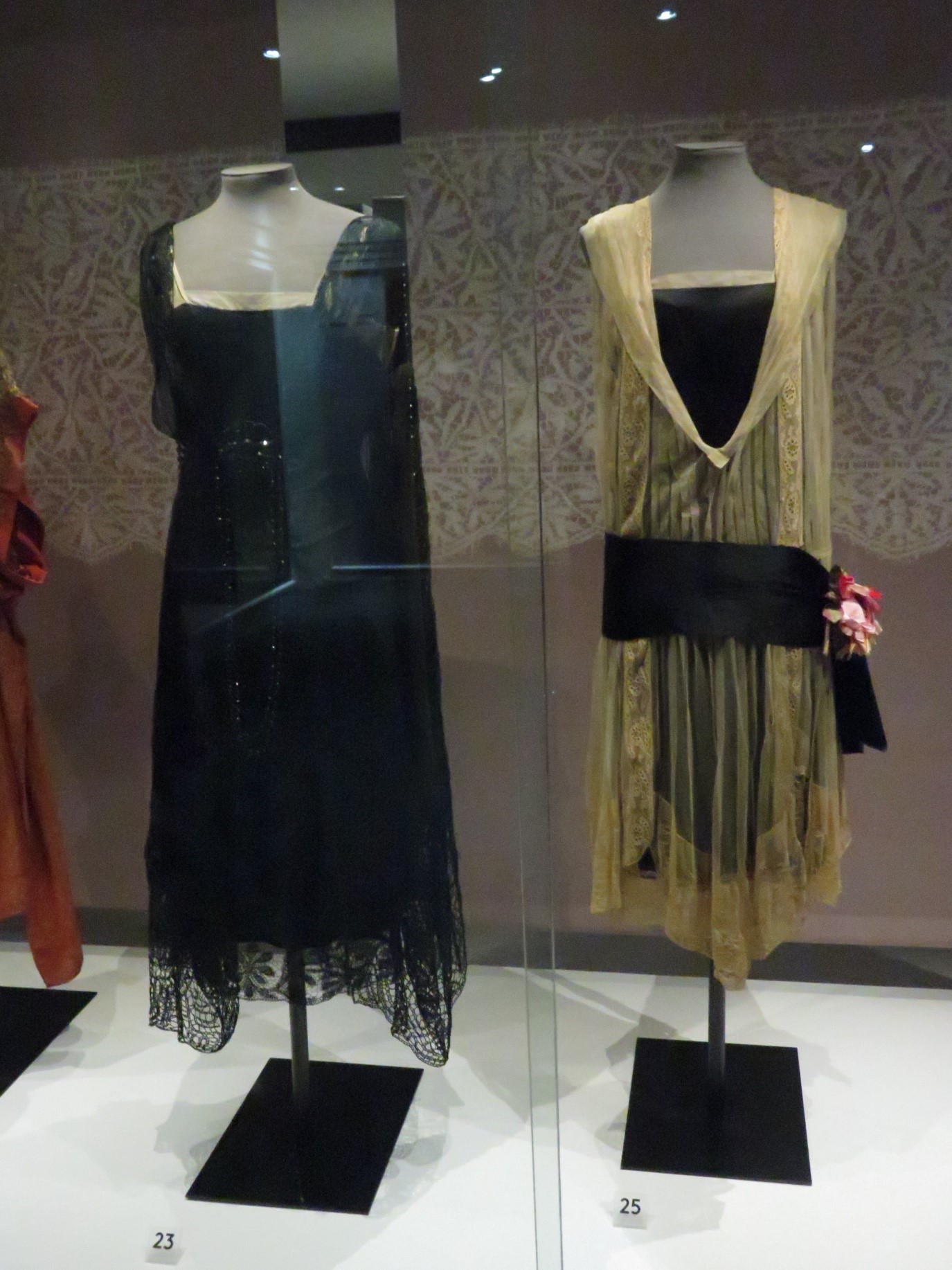
black and cream and black flapper dresses
1920s dresses, Fashion Museum Bath

These things weren't entirely gone, though, for some 1920s evening dresses were worn with a sort of light pannier to enhance the hips. For those of you who are Downton Abbey fans, you may recall this from Lady Rose's court dress:

flapper style dress but with wide hips
Lady Rose's court presentation dress, Downton Abbey Exhibition, New York

But still on the whole, fashion was much freer than it had been since the Regency. Which brings me back around to the title of this series: "Why Did We Do That?" As you might have surmised by now, I don't actually have an answer. Some of these fashion trends were established by male designers and inventors, who did not have to wear them. But women still went for them, and even in the case of crinolines were willing to risk their lives for the sake of fashion. Over the years, as a society we've decided on ideal shapes, some more natural than others, and contrived ways to make female bodies fit them.

Even today, as the article that sparked this whole series proves, women are still seeking to alter our bodies. Not everyone is back to wearing corsets, of course, but the popularity of Spanx and other shapewear certainly shows that we're still altering the bits that we're not so happy with. The only thing that's changed is the broader range of silhouettes we're trying to achieve, because fashion has given us far more choices than women of the past were allowed.

What do you all think? Why have women followed fashion at the expense of their comfort?

Friday, August 30, 2019

Why did we do that part 3

In my last post we went through the glory years of Regency fashion (and the first years of the Darcys' marriage!). But while the dresses of the later half of the 1810s were quite lovely, they signaled a transition into fashion that was going to go to extremes, first with sleeves and then with skirts.

This dress from the fashion museum at Bath shows the transition still underway. It features lots of trim, puffier sleeves, and a lower waistline with ruching at the bosom. The ruched area tapers towards the waist, a trend that will evolve to eventually form a point, for the next few decades will be all about accentuating the waist in various ways.
 
mannequins wearing men's trousers and a women's dress with frills at the bottom
1824 embroidered cotton dress, Fashion Museum Bath. As the museum notes, this dress is hand-embroidered but by the end of the decade, machine embroidery had been invented and was in use.
 
 At the beginning of the decade, undergarments were still very similar to what had been worn in the previous two decades. As this 1824-25 portrait below shows very clearly, it was still the fashion to separate the breasts, and stays were still constructed in order to do that.
 
painting of woman in white dress with brown hair and beautiful eyes
Harriott West, Sir Thomas Lawrence; as part of separating the breasts it was popular to put a brooch between them, as she wears in the painting 
 
Petticoats and pantalettes continued to provide additional layers below the outer dress, although as you can see we're moving away from those more transparent fabrics so they become less necessary for that purpose.
 
white petticoat hanging from a hanger
 1820 half petticoat, Metropolitan Museum of Art, New York
 
 As the decade continued, the petticoat took on a new purpose: to help provide shape for the dress. As the example below shows, sleeves on the petticoat helped provide volume for the increasingly puffier sleeves of the outer dress.
 
mannequin wearing a white dress with a waist just above the natural waistline
1822 petticoat with sleeves, Metropolitan Museum of Art, New York
 
 Aside from the other trends I've noted, you may have noticed some geometric patterns in the trim of some of the later gowns I've shown, and this continued to extremes. These zigzag designs were called "vandykes," a misspelling of the Dutch portrait painter whose subjects sometimes wore similarly geometric lace collars. The gown below shows an extreme example of this.
 
brown dress with jagged, pointy trim around the edges 
 1824-25 taffeta dress, DAR Museum, Washington DC
 
 The dress below shows a bit of vandyke trim, as well as the increasing sleeve size and extreme emphasis on a narrow waist that was coming in by the end of the decade.
 
off-white gown with waist near the natural waist line and puffed sleeves
1829 wedding dress, Gloucester Life Museum
 
 Sleeves would go to even greater extremes, though, for this was the era of leg of mutton sleeves.
 
two dresses, one red with a lace shawl on top and the other in a red and yellow print, both have large puffed sleeves
 Left, 1830 silk day dress, and right, 1835-38 wool day dress
 
green dress with lace fichu and giant leg of mutton sleeves
1835 green silk dress with puff sleeves and a point creating emphasis on the waist, Fashion Museum Bath
 
To support these sleeves, the petticoat was not enough, and so ladies wore "sleeve plumpers" as part of their undergarments.
 
on left white dress with puff sleeves and on the right pair of stays with padded sleeve supports
1830s long stays, with sleeve plumpers and petticoat, DAR Museum, Washington DC

pair of stays with padded sleeve supports
1830-35 sleeve plumpers with long stays and petticoat, Wikipedia

As these examples show, stays continued to separate the breasts into the 1830s. As waistlines moved down, however, short stays were no longer an option. Long stays helped maintain a smooth line and a slim waist, and they're going to get even more uncomfortable shortly.

array of dresses with varying waistlines and sleeves, in blue print, teal/light blue, yellow, rose print
This display at the Fashion Museum Bath shows a good summary of the evolution of dresses during the period we've been looking at

I'll leave you with one last dress, of Queen Victoria's. It shows a couple of things: first, that although we might think of her as a thick-waisted old widow dressed in black, she was actually quite tiny before she had all of those children; and second, tartan plaid was popularised by her as a pattern (now far enough away from the Jacobite rebellion, Victoria and others like Sir Walter Scott led a more romantic view of Scotland). As this and previous dresses have shown, materials have changed from the lightweight muslin and lace net to always be quite solid. Cotton is still used but wool and silk appear in greater proportion, and the latter comes into daytime use more.

plaid dress with puff sleeves
1835-37 silk velvet dress of Queen Victoria's, Kensington Palace, London

plaid dress with ribbons on sleeves
Side view of the dress

I hope you've enjoyed this month's installment of my little fashion series. Brace yourselves, for next month we'll be hitting maximum discomfort: corsets and crinolines.

Birmingham Back to Backs

For this blog post, I thought I would share a National Trust property, but a very different one from the country houses I usually show here....