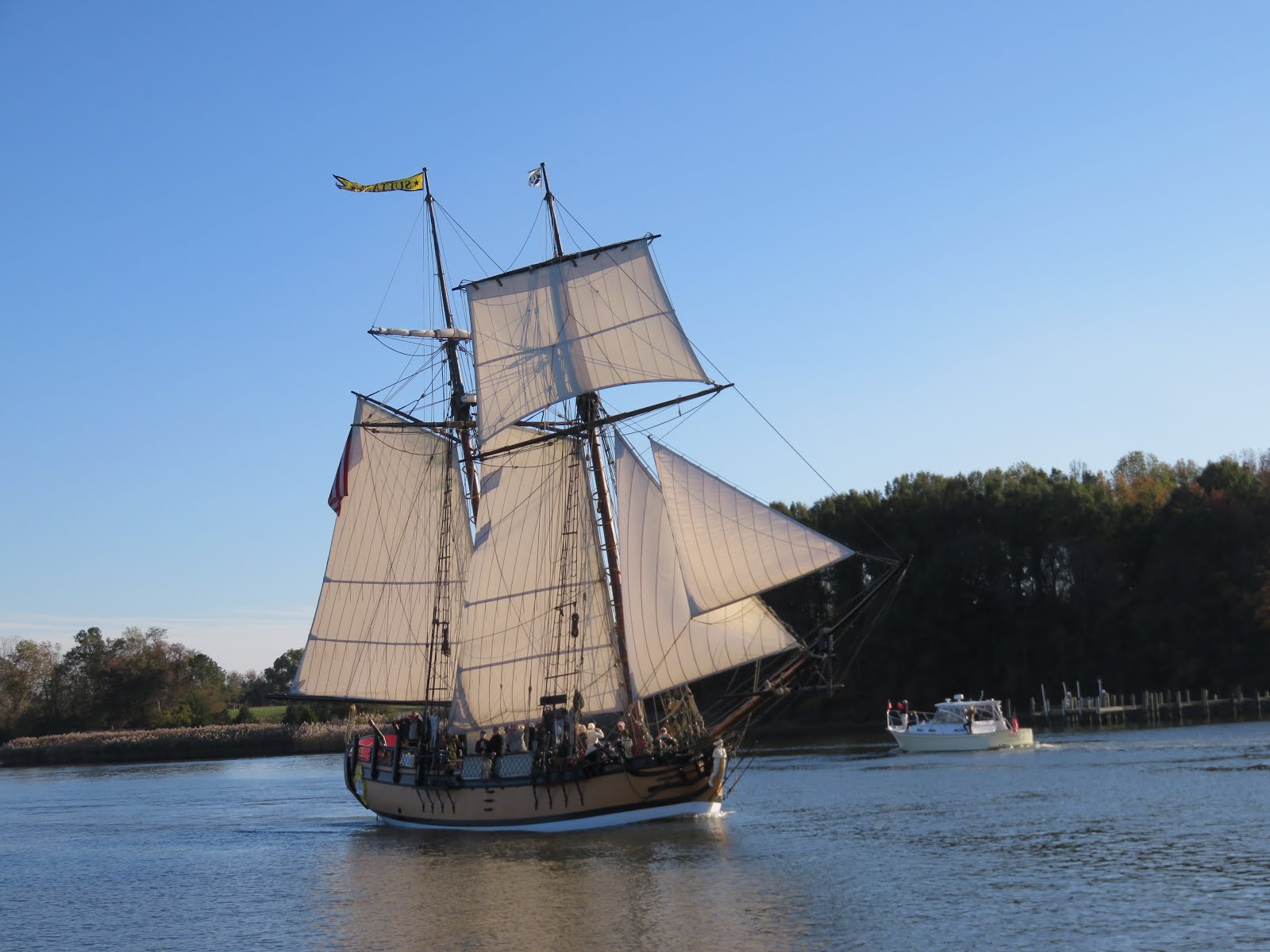
It's been a busy past couple of weekends for me! I did some more tall ship viewing at the Chestertown, Maryland Downrigging Festival, and got a lot of writing done, to boot, as I found staying in this historic town very inspiring:
I also attended the JAFF Writer-Reader Get-Together, and had a fantastic time. It was so great to get to meet up with readers, bloggers, and fellow writers, and talk about Austenesque writing and Jane Austen the whole weekend. I dressed up for tea, as I love to do:
They're gauging interest for a 2020 session, so if this sounds like fun but you weren't able to make it this year, please register!
I have loads of multimedia from five different great houses I visited during my trip to England to share with you all, and lacking any better ordering I'm going to go in what was chronological order for me, which was also generally northwards. So first up is Shugborough Estate. This is a National Trust property although more recently so, as it was given to the National Trust in lieu of death duties in 1960 and then leased to the Staffordshire County Council, and has only been back under National Trust operation since 2016.
I was particularly interested in this one because of the estate portion of its name. Often when you visit these great houses, you get to see the most noteworthy portions of the house and then the landscape gardens, and they are often now including the servants' quarters (I've read visitors are asking for these more and they're having to be converted out of offices...I expect it's the Downton Abbey effect). But Shugborough included more of the working estate, or so I had read, and the more I can learn about the more behind the scenes aspects of these great houses, the better, as estate management plays a role at points in my series.
Walled
kitchen garden at Shugborough
What I found there wasn't quite what I was expecting, but it was still useful. The "estate" portion is really more of a farm, which would have been the home farm for the estate. It's also, strangely enough, designed by architect Samuel Wyatt, who was one of the leading architects of his day (but not my favorite...we'll get to him in future posts). We tend to think of architects as specifically designers of buildings in the modern definition of the term, but back then it was still a developing role, and so you see architects better known for buildings also designing landscapes (and vice versa), also doing interior designs and sometimes even furniture, and in this case designing the layout and buildings of a farm, as you can see in the photos below:
Farmyard
at Shugborough
Mill pond behind the farm. A working mill was built into the farm buildings rather than being a separate building.
Pig
pens at the farm
There were points where it definitely felt a little petting-zoo, and it seemed popular with families with children because they do have animals still kept within the farm.
Look at this cutie!
The exhibits within the farm explained the various roles that people would have held on the farm in the Georgian era, but probably the highlight was the bailiff's house. The bailiff would have been the person responsible for managing the farm (whereas a steward like George Wickham's father would have overarching responsibility for the entire estate including the home farm and tenanted farms), and so this house is a unique chance to see how someone at that level of society would have lived, which is pretty good (although not nearly so good as in the great house), as you can see in the 360 photo and video below (all of the videos in this post are 360s, so you can either watch them as they are or pan about to see different things as you watch):
Beyond the farm, there is a dairy, which would have been part ornamental dairy (for those great ladies who like to play at farming, a la Marie Antoinette) and part functioning dairy. Only the ornamental part was open, though.
Exterior of ornamental dairy.
Interior of ornamental dairy.
The stables, next to the house, are a bit fancier than the farm.
The house itself isn't particularly remarkable compared to some we'll see in future posts, but still worth taking a look at. And it was inhabited by some interesting people: Thomas Anson, who never married and therefore the estate passed to his much more famous brother, George Anson, who as a commodore (a temporary naval rank for a captain commanding a squadron) captured a Spanish treasure ship and circumnavigated the world. The estate passed to his son, who became the first Earl of Lichfield, and in the 20th century passed to Patrick Lichfield, who was a famous society photographer (his apartment in the house is a separate tour and photos aren't allowed as his photography remains under copyright).
Shugborough Hall exterior.
The library and drawing room were my two favorites of the rooms.
The library.
The drawing room.
What impressed me most, though, were the servants' quarters, which were extensive (I believe the county council had maintained them as a museum before) and really showed a full suite of rooms (larder, kitchen, scullery, laundry, etc.) surrounding this rather nondescript courtyard:
Servants' quarters courtyard.
The kitchen had some great details like these racks designed to store
apples so they aren't touching, so they'll ripen more slowly.
I believe this was a butler's or housekeeper's office, but can't recall which.
Servants'
hall.
Storage.
That's all I've got for now, but if you enjoyed all of that multimedia, I've got plenty more for future posts! And next month's house is one that will look familiar to you 1996 Pride and Prejudice miniseries fans, so watch this space.
Now that my series on the evolution of fashion has wrapped up, I've got loads to share from my latest trip to England. I visited five different great houses and also spent some time becoming an accomplished walker in the Lake District. But I thought I'd start at the earlier part of my trip, chronologically, and share the carriage collection at the Stockwood Discovery Centre in Luton.
Rather than staying in the less-interesting larger town of Luton, I opted to stay in nearby Leighton Buzzard and take the bus over, which got me more in the mood for a carriage museum with views like this:
The carriages at the Discovery Centre are the result of more than 50 years of collecting by George Mossman, who kept these carriages as a working collection. They include both historic vehicles (the larger proportion of the collection) and replicas. Many have been used in movies. When you come in, there are a few carriages in the hallway, including this 1860 town coach:
Then another room off to the side has an exhibit, Life's Journey, which features vehicles and other artifacts from birth to death, from this governess cart, which would have been driven by a governess sitting at the front (she'd have to twist at a rather awkward angle to drive it)...
...to this circa-1860 hearse, which does not lack for Victorian-era decoration:
Also among this exhibit was a nice 1780s barouche:
This was all the appetizer, though, for the room in which a large portion of the extensive collection is shown. It is quite literally stacks upon stacks of carriages!
Of the many many carriages there, I was particularly interested in the post-chaise at the bottom of this stack. Its yellow color indicates it would have been a hired post-chaise such as many of Austen's characters who cannot afford long-distance travel in a carriage of their own would have used:
You can see the key qualities of the post-chaise from the front here: the front windows which made for better travelling as one could see where one was going, and the lack of a driver's box, as the chaise would be steered by a postillion on one of the horses.
And I was particularly glad that the window was open so you could get a good look inside. They're usually closed in carriage museums and this makes it difficult to get a sense of what it was like to actually be inside, which is the part the characters spend the most time in, in most period novels!
There was even a third room of carriages (although not stacked) beyond this one, including this mail coach:
And at the tail end, this nice circa 1770 landau:
It also had access to see a bit of the interior:
If there's one criticism I have for the museum, it's that this collection really deserved a space twice as large as what it was given. It was difficult to really see the details of many of the carriages because they were either parked really close together, or in those stacks so you could hardly see the top ones. While it made for an impressive sight, I really would have liked to get up close to ALL of them.
I've got lots more for coming blog posts — indeed, so much I decided to blog about the JASNA AGM at my personal author blog — including multimedia from some really wonderful great houses. Little hint, one of them was a filming location for the 1996 Pride and Prejudice miniseries, so I hope you'll all watch this space for more.
Well, as it turns out I made that trip to Baltimore sooner than expected! I learned that tall ship Lynx was going to be there along with Pride of Baltimore II. They're both types of schooners known as Baltimore clippers, and very much of interest to me at this point in my research. Still better, they were tied up at Fell's Point, the historic seaport and shipbuilding area of Baltimore, which turned out these schooners by the hundreds in the early 19th century. So I decided to go up and do a day sail on Pride of Baltimore II, since I'd been planning for a long time to do one on Lynx at another event a few weeks from now.
It was very weird to be going on a research trip that's only an hour away rather than a 7-8 hour flight. Unfortunately what I learned is that they were also doing a festival in Fell's Point, and it was a HUGE festival. Apparently it started as a way to raise money to keep Fell's Point from being razed for an interstate highway, but now that that threat is passed, it's just celebratory. So the views of a lot of the buildings were blocked by tents, although I was able to see some good examples of the architecture on the streets farther back. I think I'm going to pop up again at some point and do a history tour and get a better sense of what the harbour-front buildings look like normally.
Even though I didn't have to go all the way to England for this one, I did still manage to find the super-leaning old houses!
Some examples of the Georgian (called Federal-style here since we threw off George III) architecture of Fell's Point.
More house examples. There's no attempt whatsoever at the sort of architectural uniformity you see in places like London, in terrace houses. It looks like each one was built independently, to varying heights and styles.
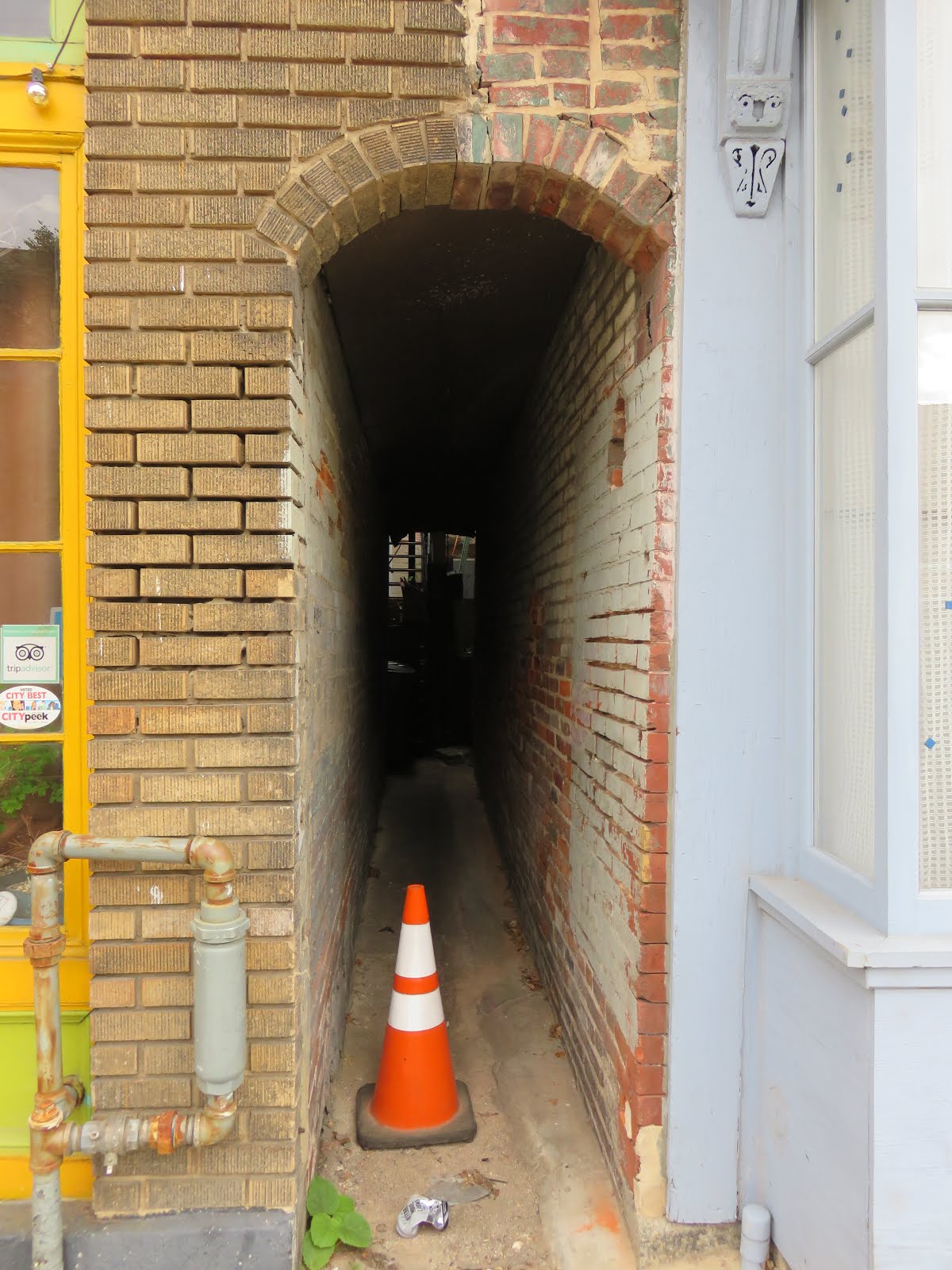
One thing that was strangely consistent was these passages, which all led to a sort of rear yard for all of the terraced houses.
Lynx and Pride of Baltimore II tied up. I love moments like this where there are enough historic elements to mentally edit out the rest and envision this as a scene 200 years ago.
The sail was great, particularly getting to see Lynx with a full spread of canvas from the vantage point of another ship. It really gives a sense of how beautiful and fast these ships were, with their provocatively raked masts and sharp hulls.
Lynx looking absolutely lovely.
Lynx seen from Pride of Baltimore. That's Fort McHenry on the left, of Star Spangled Banner fame.
I also found a nice pub serving cask ale that was not too crowded with festival-goers, and made some good progress on the journal I wrote about at the end of my last post, so in a way it was like a little miniature English trip, except I made it by local commuter rail. All in all it was a very fun and productive time!
Hello, dear readers! It's been a while since I've done an update here, and I thought I would give you an update on what I've been up to over the past couple of weeks. As you might have seen if you follow my Facebook or Twitter feeds, I've been in England burning some more shoe leather and taking loads of photos to share with you all. I visited five great houses and also spent some time in the Lake District, where I'm planning on setting a portion of A Generation's Secrets.
So watch this space for future Austen Authors posts on the carriage museum I visited, those great houses, and my experiences walking in the Lake District. For now, though, here's a picture of the incredible long gallery at Syon to whet your appetite.
I also went to JASNA's AGM, as it was in Williamsburg this year which is not too far from me (although anyone who dealt with Sunday's I-95 traffic might disagree!). I was fortunate to go with a friend who is as much a Janeite as me, and we decided to dress up the whole time, which I enjoyed even more than I'd expected I would. Although I've certainly worn the clothes all day before and dressed up for the ball at the Washington D.C. AGM a few years ago, I've never actually worn them outside. But given there are already a bunch of people in colonial dress there, it wasn't at all intimidating to walk around in Regency clothing, and it gave me a sense of how it felt to hold a parasol (and how to keep it from bopping one's bonnet).
It also made for some fun moments as we decided to walk up and down Duke of Gloucester Street, which is the main street of the historic area. It turns out a lot of people probably didn't know the difference between Regency and colonial clothing, because we got stopped a number of times by people wanting to take our pictures or have photos taken with us. Our brighter Regency colors and parasols perhaps stood out from the more workman/woman-like clothing most of the people in the colonial area wear.
I think we were not the only ones who dressed up more since it was in Williamsburg, because I felt like I saw a lot more people in period clothes over the whole course of the conference than there had been in D.C. Wearing a new bonnet myself did not prevent me from having bonnet/hat envy as there was some incredible millinery on display.
The conference itself was focused on Northanger Abbey, which isn't my favorite work of Austen's, although it is one I appreciated more the second time I read it. And over the course of the conference I found myself glad that it was on a book I hadn't studied as much, because hearing various analyses made me consider it in different ways, and I think I appreciated it far more by the end of the conference.
The most interesting sessions I attended were:
Jocelyn Harris' opening plenary, where she framed Northanger Abbey in very modern terms like "gaslighting" and "fake news" and had a harsher view of Henry Tilney (as sexist and proud of his education and position as a man) versus my own (and I think many others') take of him as teasing and flirtatious. I didn't necessarily agree, but it made me think.
Kristen Miller Zohn's talk on portraiture and architecture as it relates to Northanger Abbey, particularly the common trope of portraits coming to life either literally, or in someone viewing a portrait and then immediately meeting the subject. Until she called it out, I had not realized that Austen used this in Pride and Prejudice, nor that I had planned the same within my outline of The Crimes of Elizabeth Darcy without consciously understanding I was doing it. I wonder if Austen's use was conscious or unconscious?
James Nagle's talk on the British Army. Sometimes I find both Austen talks and Austen books too narrowly focused on just examples from her work, but Nagle did a fantastic job of explaining the much broader context of how the army worked and was structured, and then explained the examples seen in the books.
Roger Moore's closing plenary on what Austen had to say about the Reformation. Moore also used the example of Northanger Abbey as a fictitious abbey to tell the greater tale about what happened to the abbeys seized by Henry VIII and their legacies.
I think my favorite part of the ball is actually the procession beforehand. I remember from the Washington DC conference how amazing it was to see so many people dressed in Regency garb. While there we were riding on escalators, though, in Williamsburg there was a torchlight procession through the historic area.
It was so historically authentic that we needed modern gentlemen in Regency clothing to shine their phone flashlights on patches of horse manure so our dresses would not be soiled. I feel reasonably sure that's the first time JASNA has been THAT historically accurate!
That's not it for my traveling and meeting up, however. For once I actually get to do some location research MUCH closer to home, as Baltimore is also one of the settings in A Generation's Secrets, so I'll be popping up there at some point. And I'll be attending the JAFF Reader Writer Get Together in November, so I hope I'll get a chance to see some of you there!
And yes, in and amongst all of this, I've also been getting some writing in. Mild spoilers for what one of the plotlines will be in A Generation's Secrets below...
One of the elements of the AGS plot are found journals of Lady Anne Darcy's (one of the elements that drives the title) and I decided to write the entries as an actual journal, meaning long-hand in a journal. Although not with a quill pen...I've had quite enough of that for now! I think it's helped to form a different voice for them, and one more in keeping with them being journals than if I had just tried to type them out in and amongst the rest of the story. So I'm currently working my way chronologically through the pertinent events in Lady Anne's life, and then I'll be back to the main manuscript, pulling from the journal entries as I need them.
If you can read my handwriting (which I realize is a big if!), you can get a little sneak preview below, and see how the medium helped influence the tone:
I think that's it for now, dear readers! I hope to see some of you in November!