Last month we had a look at Hawkshead, where I stayed for several days. One of the places I went from my base there was Coniston, which I thought I would share this month. I was really enjoying my ability to walk to the various places I wanted to visit, but by Coniston the rain had well and truly set in.
Fortunately I had brought a rain cover for my camera, so I was at least able to capture some photos even if they were a bit drippy!
I decided I would just set out anyway, but this day had REALLY serious rain. My water resistant pants stopped resisting the water, and even my supposedly waterproof raincoat was starting to soak through. And those mesh shoes got completely squelching wet, ugh.
There's a saying in Britain that is basically there is no bad weather, just the wrong clothing, and I was definitely feeling like I had not geared up properly as I walked past British people in their waterproof jackets, trousers, and boots.
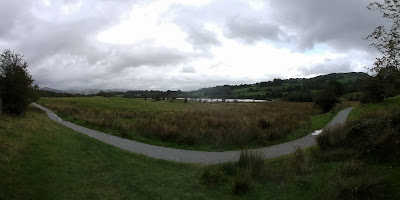
The walk itself WAS nice, though, part of it along the long distance route called the Cumbria way, along this nice lake.
There were also portions through the woods, which felt a little mysical in the damp.
Sheep are weird.
Eventually, the fells around Coniston started to come into view.
Coniston itself is a quaint town with lots of inns and pubs. I was quite ready to spend a little time drying out in a pub after that walk, before the trip I'd booked on the Steam Yacht Gondola.
Steam Yacht Gondola was originally launched in 1859, and although she's been largely rebuilt I'm always interested in riding on anything that can help me understand how transportation has evolved. Gondola began her life serving Victorian tourists, and after a period of dereliction, is now restored and doing the same for modern tourists, now owned by the National Trust.
After my ride on Gondola, it was time to walk back to Hawkshead. I took a different route so that I could see different things, including a very atmospheric set of steps somewhat randomly in the middle of the woods. I'm not sure if they used to belong to something or were just a very ambitious addition to the trail.
Just posting a couple more Lake District 360s for an upcoming blog post.
In my last (admittedly some time ago!) post, we were walking back from Wray Castle and I was describing some of my gear and means of navigation. So I think it's time for Hawkshead, and I am excited about this one as it's a delightful little village.
Because of its location (if I recall correctly originally it was more of a transit center than it is today), Hawkshead has several old coaching inns and loads of historic buildings, but it is very intact historically. There are no incongruous buildings in the village center to throw off the sense that you're in a historic place. I don't typically get a chance to stay in places like this for multiple nights, but its proximity to loads of walks meant I had the opportunity to do so here, and I loved it.
I'm just going to share loads of photos with a wee bit of commentary, because that's really how you can see how delightful it is. And keep your eye peeled for the video walking tour!
One of the attractions in the village is the Beatrix Potter Museum. Given how small Hill Top is, I liked that this was a separate attraction, and nicely enough it's in an old building, so I enjoyed it doubly.
The village also has a lovely old church.
There is also an old grammar school, which you can (and I did) tour. Its most famous attendee was Wordsworth. The tour was very interesting, and I hadn't realized that there were so many more schools for boys of the upper middle / upper class during the Georgian era, like this one. Eton is the one you hear about but I think I might be making use of this one in book 5. I wasn't able to tour Eton the last time I was in that area and I always like to write from places I've been if possible.
Apparently carving of things was not only allowed but encouraged. I guess it kept the boys out of worse trouble!
A little bit outside of the village is the old manor:
Whoops, one more batch from Hawkshead in the Lake District, for an upcoming post. 🙂
I know it's been quite some time for me to post in my blog, despite my best intentions of keeping the Lake District series going. I do intend to get back on a regular posting schedule and finish it, but first I wanted to give an update on the editing for A Generation's Secrets, which is also the reason why I've been absent for a while.
Long story short, after all of the wonderful feedback people gave me during the online beta, I went to make edits to the manuscript, and something happened. The earlier edits were in the file, and the later edits were in the file, but there was a big chunk in the middle (including some pretty substantially rewritten scenes) that was gone.
I'm a fairly tech-savvy person and I went to check the version history and there was a huge time gap. I knew there was a time gap because I had been tracking what edits I had made in a Google spreadsheet, and there was a span of dates in the spreadsheet's version history that did not have corresponding dates in the Word doc. I have some theories as to what happened but suffice to say those edits were well and truly gone and would need to be rewritten.
I was pretty devastated by this, I'm not going to lie. The actual amount of work that was gone was not huge, but I had this feeling that I would never rewrite those sections the same way again, and that was tough to get past. So I took a little hiatus and did some arts and crafts in my spare time through the end of the year.
I am back at it now and have rewritten everything, and I'm nearly done with my first readthrough of the manuscript since. I'm not sure when it will be ready to publish although it's feeling fairly clean at this point (that might still mean months worth of readthroughs with a story of this length!).
When the pandemic first started I felt reasonably sure I would be able to finish the book by the end of 2020, with all the extra time I would be spending at home. I didn't account for the loss of work of course, but I also didn't realize just how long it would take to work my way through a book this long. It just takes extra time to do everything because it takes more than a week just to read through it.
So I'm pretty darn confident I will publish in 2021 given it's only January, but I have no idea what month it might go out. Watch this space, and I'll keep you all posted when it's closer to "typo squad" time and then actual publication.
So I'm overdue in sharing more walking photos and videos from the Lake District. And I thought while I do that I would also share a bit more about the basics of walking there.
One of the things I love about England is that there is basically a way to walk pretty much anywhere you want to go. This isn't accidental -- it's the result of years of lobbying and civil disobedience (the most noteworthy event of the latter being the "Mass Tresspass" of Kinder Scout in Derbyshire). But what it means is that there are both ancient rights of way that have been maintained and more recent walking trails and footpaths where anyone has the right to walk. In the Lake District where so much land is owned by the National Trust, this is even more pronounced.
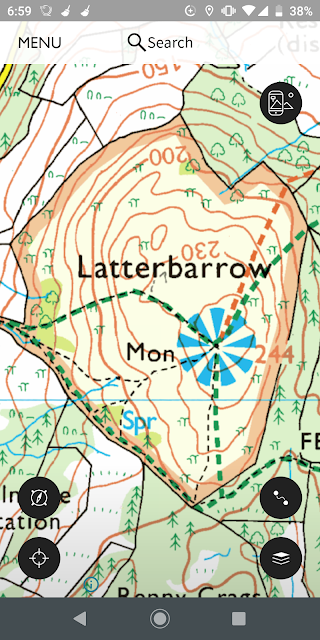
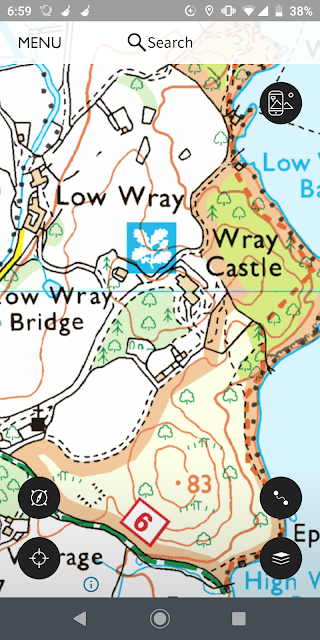
There's also an extensively detailed set of walking maps for the entirety of Great Britain, produced from ordnance surveys. These ordnance survey maps have been available on paper, and more recently on an app. I have to admit that I've found the paper maps complicated and unwieldy, and although I carried one on this trip in case I lost signal or my phone battery died, I loved using the app because my phone GPS immediately showed me exactly where I was. Unfortunately you can't see the GPS in these screenshots I took later, but this is what the maps look like on a phone:
It takes some time to learn all of the different markings, but generally a green dashed or dotted line is some sort of walking trail. For me one of the fun things was planning out my route the evening or morning before my walk, deciding what trails I wanted to take and therefore what I wanted to see. The maps detail both topography and noteworthy sights, so they're great for that purpose. The British are also great about marking footpaths and putting up signs, so I could often walk for a very long time without even needing a map check.
I also wanted to talk a bit about gear. One of the other things that's nice about walking in Britain is you're never really THAT far from civilization, and there are usually other people on the path. So while I did carry a paper map, compass, emergency whistle, and small first aid kit in addition to my other supplies in a little waterproof folding backpack, that was the extent of what I needed. I believe I mentioned the trekking pole I purchased, and I was very glad I had that for the remainder of the trip -- it makes stream crossings easier by giving you a third "limb" for balance, and it also eases the burden on joints when going downhill.
The big thing I had regrets about was in waterproof gear. Some of my things were waterproof -- my backpack kept my electronics dry when it rained (and boy did it rain in the second half of my time there), and I brought a waterproof case for my camera, so I was still able to take some pictures when it was raining. However I did a much better job of protecting my electronics than my person! I had a water-resistant rain coat and water-resistant hiking pants, and when I spent enough time in the rain, both of them eventually soaked through. Whenever I get to go back, it's going to be with a new fully waterproof rain coat as well as rain pants.
I also gambled when it came to shoes. You can see the ones I wore for the majority of my hiking above. They are a super lightweight pair, just a bit more than a barefoot shoe, and they were absolutely fantastic...until they weren't. When the weather was dry the light weight gave me a much better spring in my step than I've found in regular hiking shoes, and I'm sure I was able to rack up more miles than I might have been able to otherwise because of this. However they were designed to be worn barefoot, and every once and a while the back of my heels would blister up dangerously. And of course, they were decidedly NOT waterproof. I thought I'd solved for this by buying a pair of rubber shoe covers, but those broke on the first day I've used them.
So for the remainder of my Lake District posts, if it looks wet, imagine me walking in squelching wet shoes. But hey, at least the views were still beautiful! So now for some of those views with pictures and a walking video from my walk back from Wray Castle.
By this point in my Lake District trip, I was in pretty good shape. So good that what I'm about to show you I actually walked to after Latterbarrow, which I shared in part 3. But I thought it would be better to focus on the house for this one post, so one day's worth of walking is actually going to be three posts! This month I'll share Wray Castle, and then next month the walk back to Hawkshead (aka more lovely Lake District scenery!).
Wray Castle is a Victorian neo-gothic "castle" (which is to say house built with crenellation and other features to make it look like a castle but not really a castle), so it's from an era I don't usually share houses from. I think it's useful to see where styles were going to evolve to after the Regency, though!
The house was built by a retired surgeon, who must have married well for it was funded with his wife's fortune! Beatrix Potter spent a summer here when she was 16, so it's a key part of her story within the Lake District, too. But without further ado, let's look at some photos...
The gatehouse provides a good sneak preview of the castle
The walk along to the castle features more lovely landscape.
As you can see, though, the weather was turning rainier!
The exterior is this sort of Victorian castle fantasy.
And the interior keeps the fantasy going!
There are loads of gothic details like this window.
This ceiling is just a little bit bold!
It's not all over the top, though. I love the painting on this fireplace.
The main hall from another angle.
When I was a kid, I really wanted to live in a turret. And I don't think I'd turn it down now if the opportunity appeared!
More gothic detailing.
Upstairs in the main hall.
The impressive ceiling in the main hall.
A less over-the-top ceiling compared to the others, but still interesting!
And here are some 360s:
Some 360s of Wray Castle in the Lake District for an upcoming blog post.






.jpg)
