 |
| From PBS site |
Nancy Lawrence did a great job of introducing the series in her post, so I'm going to dive right in and we may as well start with costumes, since it's a costume drama. According to the press pack it's set in 1819, which was a surprise to me. As you might recall from my series on fashion, we should be getting into an era of widening skirts and sleeves, much more trim, and more silks than muslin, but this was largely absent.
Of course as is basically always the case for Regency era costume dramas, ladies' breasts are smashed together to create cleavage rather than keeping them separate as was actually the fashion then. I doubt we'll ever see one that uses busks or stays that separate the breasts. And I thought they were doing better with dressing the resident dowager, Lady Denham, for at least she was wearing higher waisted open robes that showed the transitional style of the 1790s:

But then she shows up in a sack back gown. By 1819 this is a 40+ year old style. Do you know anyone who wears clothes 40 years out of date? If I still had even a 20-year-old dress I'm pretty sure it wouldn't still fit. I don't know why costume dramas always want to dress older women (and often they are older women with ample money to buy new dresses) in these older dress styles. As I posted in my series on fashion, it's much more likely they would wear a more matronly or even reworked fabric, but still in the newer style and as a closed gown rather than an open one.
But then just as I thought all was lost, Charlotte Heywood shows up at a ball wearing this bit of loveliness:
Aside from the smashed breasts, everything about her hair and dress is absolutely spot on to the time. Of course for most of the rest of the series she runs around with her unrealistically short hair down, so this was like a strange, accurate oasis. There are other oddities as well, like women wearing black when not in mourning, and the general inaccuracy of women clearly wearing substantial amounts of eye makeup (one of the things I loved about the 2009 Emma is that they avoided the temptation to put eye makeup on the female lead and gave Romola Garai a lovely natural look). I will say the jewelry was pretty consistently on point as well, with a lot of great earrings and festoon necklaces.
The men generally fare much better; Sidney Parker in particular shows the post Beau Brummel color palette (which is to say almost exclusively black). But then Tom Parker shows up at the same ball where Charlotte Heywood wears that lovely dress wearing some sort of weird maroon silk pajama getup that does not come from any period in history ever.
It's almost like they had one person on the costume department who knew what they were doing, and everyone else just went with this sort of weird Regency free for all! The same applies to set dressing. Two of my gauges for period dramas are teacups and carriages. The teacup game is, surprisingly, mostly on point, and the glassware is very on point. As are the carriages, including a wonderful high perch phaeton, which I don't think I've seen in any other period drama. They must have blown the horse and carriage budget on the phaeton, though, because the same four black Friesians pull every single carriage in the show!
Sanditon is shown as Austen describes it, a fishing village metamorphosing into a seaside resort, and it's got lots of great detail in that.
 |
| From Sanditon press pack |
The shows accurately portrays women bathing from machines, which is great to see.
 |
| From Sanditon press pack |
I also liked the detail of game hanging from the back of a stagecoach. They often carried game (legally, these were supposed to be gifts from someone allowed to shoot game) up to London; around Christmastime apparently some stagecoaches wouldn't carry passengers because it was more lucrative to carry game and parcels.
But (you knew there was a but coming) there's a lot of weirdness when we get into the houses. On the plus side, Trafalgar House has a print room (where the room is decorated with prints affixed to the walls), which I don't think I've seen portrayed in a period drama before. Apparently they based it on Sir John Soane's house in London, and while I don't see a strong resemblance, the inspiration is at least spot on for the period.
But Sanditon House's interior was apparently dreamed up by the set designer as some sort of weird gilt pseudo baroque fantasy (he cited Lady Catherine de Bourgh in the making of feature, so I'm presuming he means the 2005 film). The exterior was filmed at Dyrham Park, so I don't know why they didn't just film at an actual baroque interior. Seems like it would have been nice to save money on building that set to hire some extra carriage horses or something. For contrast, here's the interior from the movie and then a video of Burghley House, where the 2005 Pride and Prejudice was filmed.
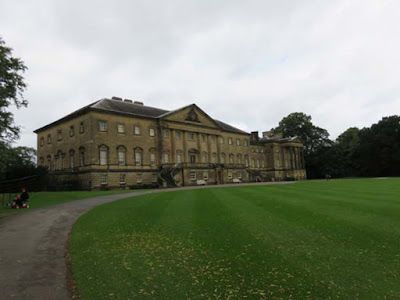
And then there's Denham Park, most inexplicable of all. It's pure Regency Gothick, which is great to see in a period drama set in this time. The thing is, it would have been the latest fashion, so while it absolutely makes sense to feature in a show like Sanditon (Sidmouth, which I featured in a previous post, was building up at this time and filled with such architecture), it doesn't make sense to be portrayed as so old it's leaking! Strawberry Hill, the granddaddy of this architectural style, was begun in 1749, so maybe if this house followed the trend early on it would be old enough to leak, but it's still younger than Sanditon House.
 |
| Denham Park, photo of the television by me - I have not been able to find this house online anywhere! |
The interior decoration is even more out there than that of Sanditon House — it's more Hollywood Regency than Regency Regency. Everything's all just too dark, as if they're trying to be edgy by having so much black in the rooms (and in dresses), but gothic in that era wasn't about black; it was about the actual architectural features. And what's up with all these marble floors for rooms other than entrance halls?
 |
| From Sanditon press pack |
I saved the worst incongruous bit for last, because rather than a historical detail this is actually part of the plot. A letter is shown accurately written as "crossed," with lines running in different directions to save paper. I think this might be another first for an Austen adaptation, so good on them for that. BUT a bachelor also corresponds with an unmarried woman; this is known to many people and nobody has any issue with it, when as anyone who's read Sense and Sensibility knows, unmarried men and women did not correspond unless they were engaged.
I found the historical details of Sanditon fairly maddening because there were some things they got so right, and some things they got so wrong. I'm not even going to start on the dancing or the treatment of a pineapple as rare (rather than expensive) because I've already rambled quite enough. But I did actually enjoy the overall story. The romance is good, and it's great to see characters of color with substantial roles in a period drama. There is decidedly more sex than your usual Austen adaptation and it did feel like that was in more for titillation than the stronger plotlines. The ending definitely leaves you wanting a second series, and it sounds like whether that happens might depend on its success in the USA. So if you're not watching, give it a try, and if you are, I'd love to hear what you think. What historical details stood out to you?















.jpg)
